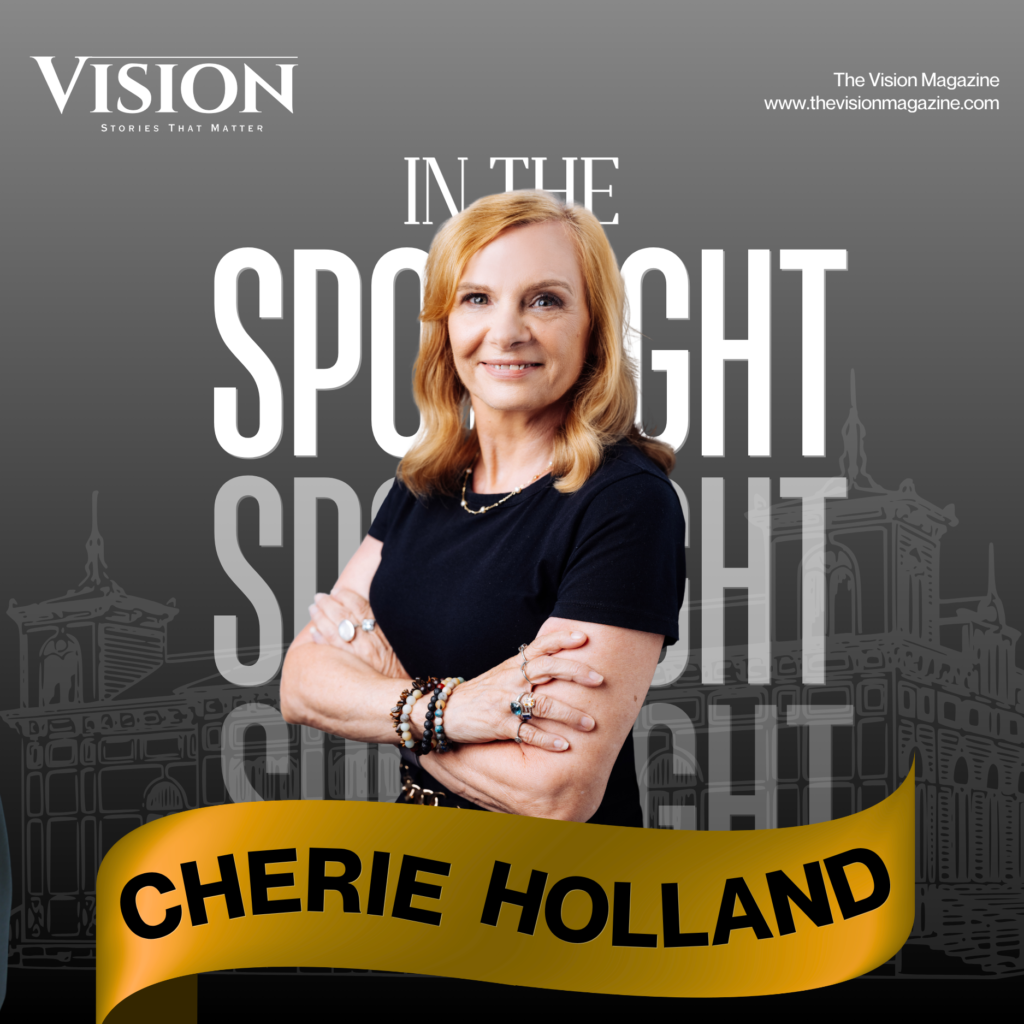
Building human-centred leadership through FLUIDMETHOD©, formed by 25 years across high-pressure industries!
A manager sits late in the office, staring at numbers that look strong on paper, yet the team feels distant, energy feels low, and conversations have grown careful rather than open, creating a doubt that something important is slipping through the cracks even while targets are being met.
This is a reality many leaders recognise, where pressure to perform leaves little space to understand people, and over time, the gap between results and real connection begins to widen. Cherie Holland has spent more than 25 years working within this space, across 6 countries and industries such as engineering, mining, property, education, and systems development, where expectations rarely soften, and leadership is tested in real time.
Her experience spans from capital cities to remote regions of Australia, places where decisions carry weight and leadership cannot rely on rigid systems alone. These environments shaped her belief that clarity, adaptability, and human understanding must work together, especially when uncertainty becomes the norm.
As CEO of RC Consultancy Group, she focuses on human-centred leadership, placing people at the core of performance rather than at its edges. Her framework, FLUIDMETHOD©, grew from this belief, guiding leaders to navigate complexity with purpose while staying grounded in what truly drives teams forward.
What stands out in her work is the steady balance between strategy and empathy, where outcomes are achieved without losing sight of the individuals behind them. In a time where leadership often feels stretched thin, Cherie offers an approach that feels real, considered, and anchored in everyday experience.
Leadership is not One-Size-Fits-All
Leadership often gets treated like a fixed formula, but real-world experience tends to dismantle that idea quickly. What works in one environment can fail in another, especially when cultural and operational realities shift.
One of the most defining insights for Cherie came from working across both highly structured international environments and remote Australian operations. She realised that leadership is not universal in its application; it must be deeply contextual.
In remote environments, trust is not built through hierarchy; it is built through presence, consistency, and action. That reformed how she approaches partnerships globally. Regardless of geography or culture, people respond to authenticity and reliability far more than authority.
When Innovation Starts with a Problem
There is a tendency to romanticise innovation as a flash of brilliance. In practice, it often begins with something far less glamorous, a persistent operational problem that refuses to go away.
One of the most significant innovations Cherie co-developed was the Remote Overburden Mine Operations Monitoring and Assistance System. The idea emerged from a very real operational challenge: how to improve performance and decision-making in remote mining environments where delays and inefficiencies had a direct commercial impact.
The “spark” wasn’t a moment of inspiration; it was a problem that needed solving. She and her team combined operational insight with technology to create a system that enabled real-time monitoring and support. Within 18 months, the site transitioned from one of the lowest-performing to one of the highest-performing operations.
In her experience, innovation is rarely about invention for its own sake; it is about solving meaningful problems with practical impact.
Turning Diversity into Decisions
Many organisations talk about diversity of thought, but fewer manage to translate it into something tangible. Without structure, varied perspectives can remain just that, perspectives without outcome.
Cherie’s approach is grounded in structured inclusion. Diversity of thought is only valuable if it is effectively harnessed.
She focuses on creating environments where perspectives are not only heard but translated into actionable insights. This involves clear frameworks for discussion, disciplined decision-making processes, and an emphasis on shared outcomes.
Innovation becomes sustainable when people see how their contributions form results. That alignment is what makes solutions “stick.”
Why Ethics Holds the Line
Ethics is often framed as a boundary, something that limits speed or flexibility. In high-pressure environments, that assumption can create long-term damage.
For Cherie, ethics is not a constraint; it is a strategic advantage.
In high-stakes environments, she has seen how decisions made without ethical grounding may deliver short-term gains but often create long-term risk. By embedding ethics into decision-making, she has been able to build trust with stakeholders, maintain compliance, and sustain performance under pressure.
An ethics-first approach creates clarity. It ensures that even in uncertainty, there is a consistent standard guiding actions.
Growth Begins Where Assumptions Break
During downturns, most businesses move defensively. The instinct is to shrink, protect, and wait. That instinct can also limit opportunity.
During a downturn in the engineering sector, Cherie chose not to follow that path. She challenged the assumption that the business had to remain within traditional markets.
They pivoted into conveyor manufacturing for the cardboard packaging industry, an industry far less impacted by economic fluctuations. At the same time, they established local spare parts supply for European machinery, reducing dependency on international delays.
This shift not only stabilised the business but also drove growth during a period where others were declining. It reinforced a key lesson for her: constraints often create the conditions for innovation.
Mentorship, Without Lowering the Bar
There is often a tension between supporting people and pushing them toward results. Many leaders lean too far in one direction.
Cherie draws a clear distinction. Mentoring and coaching serve different purposes, and both are essential.
Mentoring provides guidance based on experience, helping individuals navigate complexity. Coaching, on the other hand, focuses on unlocking potential and encouraging ownership. She balances the two by being intentional about when to guide and when to step back. A strong employee-centric culture is not about lowering expectations; it is about equipping people to meet them.
When individuals feel supported and challenged in equal measure, performance naturally follows.
Staying Sharp Across Industries
Analysing trends across industries demands more than just attention. It requires a way of thinking that connects patterns instead of isolating them.
For Cherie, it comes down to curiosity and discipline.
She maintains a structured approach to analysing data, market conditions, and operational performance, while remaining open to emerging trends and shifting dynamics.
Working across industries has taught her to look for patterns rather than isolated signals. Whether in manufacturing, property, or education, the underlying principles of performance, risk, and opportunity are often consistent.
The Thread Which Connects Everything
Different sectors may appear unrelated on the surface, yet the fundamentals that drive them often overlap more than expected.
For Cherie, the common thread is systems thinking. Every sector she has worked in, engineering, property, education, or resources, relies on interconnected systems. Understanding how those systems interact is key to driving performance.
At its core, leadership is about aligning people, processes, and strategy within those systems to achieve sustainable outcomes.
Growing When Others Pull Back
Economic downturns tend to expose how well a business understands itself. Growth in such periods rarely comes from instinct alone.
For Cherie, the most critical factor was clarity of insight. They analysed not just where revenue was declining, but why. That allowed them to identify opportunities others were overlooking. The decision to pivot markets, optimise operations, and introduce flexible workforce structures enabled both revenue growth and productivity gains.
It was not a single bold move; it was a series of aligned decisions grounded in data and executed with discipline.
Pressure Without Compromise
Balancing compliance and growth is often treated as a trade-off. In reality, the challenge lies in how systems are designed.
Cherie ensures this balance by embedding structure into execution. Compliance and best practice cannot be reactive; they must be integrated into daily operations. She focuses on clear governance frameworks, defined processes, and continuous monitoring.
At the same time, growth requires agility. For her, balancing the two comes down to ensuring that systems are robust enough to manage risk while flexible enough to adapt.
What Remote Australia Teaches About Leadership
The environment changes leadership visibility. In some places, distance creates detachment. In others, it demands presence.
In remote Australia, Cherie experienced leadership as highly visible and deeply personal. You cannot lead from a distance; you must be present and accountable.
In capital cities, complexity increases, but the principle remains the same. Leadership is not about scale; it is about connection.
She believes emerging leaders often underestimate the importance of presence. Regardless of the environment, people need to see leadership in action.
The Next Frontier of Innovation
As technology advances, the gap between capability and human application continues to widen. That gap shapes the next wave of meaningful innovation.
If given the opportunity to develop another patent, Cherie would focus on a system that integrates AI-driven decision-making with human-centred leadership principles.
While AI is advancing rapidly, she observes a growing gap between technological capability and human application. A solution that bridges this, ensuring decisions remain ethical, contextual, and people-focused, would have a significant impact.
In her view, the future of leadership is not about choosing between technology and humanity; it is about integrating both effectively.
Reflection
Leadership today requires more than technical capability or strategic insight. It demands adaptability, ethical clarity, and a genuine commitment to people.
Through FLUIDMETHOD©, Cherie has sought to create a framework that reflects this reality, one that supports leaders in navigating complexity while remaining grounded in purpose.
Because ultimately, leadership is not defined by position or title. It is defined by the impact created and the people brought along.