


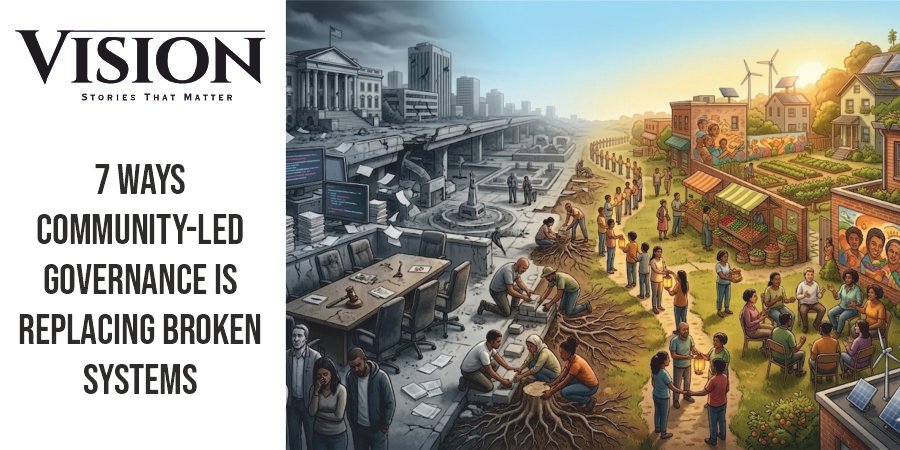
There’s a shift happening across the United States. It doesn’t come with sweeping legislation or headline-grabbing reforms. It shows up in neighborhoods where people have stopped waiting.
For decades, large institutions promised efficiency, scale, and order. What many communities experienced instead was distance. Decisions made far away. Systems that responded slowly, or not at all. The result is a growing loss of trust.
Community-led governance is filling that vacuum. Not as theory, but as practice. It’s a model where the people most affected by decisions actively shape them. That shift is beginning to outperform traditional systems in ways that matter: speed, accountability, and relevance.
At its core, community power challenges the idea that governance must be centralized and hierarchical, arguing instead for local control and shared responsibility.
Here’s how that change is unfolding.
1. Decision-Making Moves Closer to Real Life
Traditional systems rely on layers. Community-led governance removes them.
Instead of escalating issues through bureaucratic chains, local groups decide and act in real time. Whether it’s allocating neighborhood funds or resolving civic issues, decisions are made by people who live with the consequences.
The difference is not philosophical. It’s practical. Faster responses. Fewer blind spots.
2. Housing is Being Reclaimed Through Community Ownership
One of the clearest examples is housing.
Community land trusts are expanding across the U.S., offering an alternative to speculative real estate markets. These nonprofit models hold land collectively, ensuring long-term affordability and preventing displacement.
This flips the usual equation. Housing stops being a commodity first and becomes a shared resource.
For families, it means stability. For cities, it reduces the cycle of displacement that top-down policies often fail to control.
3. Marginalized Communities Are Designing Their Own Systems
In many cases, community-led governance is not just about efficiency. It’s about survival.
Across the U.S., Black and Indigenous communities are building intentional spaces rooted in shared governance, cultural restoration, and ecological sustainability.
These are not symbolic projects. They are functioning systems where land, resources, and decision-making are collectively managed.
The deeper shift here is ownership of narrative. Communities are no longer adapting to systems that exclude them. They are building systems that reflect them.
4. Accountability Becomes Immediate and Visible
In centralized systems, accountability often feels abstract. Complaints disappear into processes.
Community-led models change that dynamic. When decision-makers are also neighbors, accountability is direct. People see who is responsible, and results are visible.
This creates a feedback loop. Problems are identified faster, and solutions are adjusted quickly.
The system becomes responsive because it has to be.
5. Digital Communities are Redefining Governance Models
Governance is no longer limited to geography.
Online communities, especially open-source ecosystems and platforms like Discord, are experimenting with decentralized decision-making. These systems often include community-designed rules, appeals processes, and moderation structures that balance fairness with flexibility.
What’s emerging is a new layer of governance. One that is participatory, iterative, and shaped by its users.
These models are influencing how offline communities think about structure and control.
6. Collective Problem-Solving Replaces Passive Complaints
A common failure of traditional systems is the gap between reporting a problem and seeing it resolved.
Community-led governance narrows that gap. People are not just reporting issues. They are organizing around them.
This shift from passive complaint to active participation changes outcomes. Issues that linger for months under centralized systems are often resolved faster when communities coordinate directly.
It also changes mindset. Governance stops being something done to people and becomes something done by them.
7. Trust is Rebuilt Through Shared Ownership
Trust is the real currency here.
When people feel excluded from decision-making, trust erodes. When they are involved, even imperfect systems gain legitimacy.
Community-led governance rebuilds trust not through promises, but through participation. People trust what they help create.
And that trust has ripple effects. Higher engagement. Better compliance. Stronger social cohesion.
Why this Shift Matters Now
This is not a fringe movement. It is a response to structural fatigue.
Large systems are struggling to adapt to local complexity. Communities are stepping in, not because it’s idealistic, but because it works.
A community is more than a group of people in the same place. It is a shared identity shaped by common experiences, values, and needs. That shared understanding is what makes localized governance effective.
It sees nuance that centralized systems often miss.
The Tradeoff Few People Talk About
Community-led governance is not without challenges.
It requires participation, which not every community can sustain consistently. It can be uneven. It can depend heavily on local leadership and engagement.
But even with those limitations, it addresses a deeper issue: relevance.
Traditional systems often fail not because they lack resources, but because they lack proximity. Community-led models restore that proximity.
The Direction Ahead
What’s emerging is not a full replacement of government systems, but a redistribution of power.
A hybrid model is taking shape. Institutions provide scale and resources. Communities provide context and control.
The systems that will endure are the ones that combine both.
Because the future of governance is not about who holds power. It’s about how close that power sits to the people it affects.


