

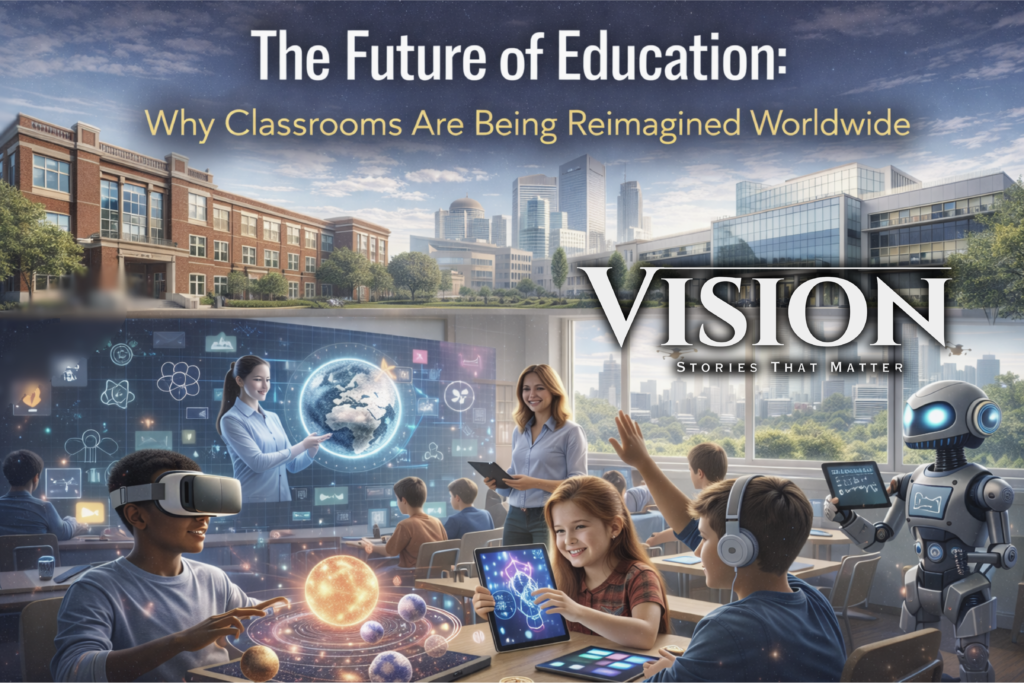
Education has always been the bedrock of progress. However, in 2026, the classrooms across the world are witnessing a paradigm shift in education that is one of the most dramatic in modern history.
The conventional system of education, where students sit in rows and learn from textbooks and standardized tests, is being disrupted by technology and artificial intelligence, and the realization that the one-size-fits-all approach to education is no longer valid in the rapidly changing world.
Today, students are learning for jobs that have not yet been invented. Artificial intelligence, automation, climate innovation, and digital economies are giving rise to new occupations that require flexibility, innovation, and emotional intelligence. Learning by rote is no longer sufficient. Critical thinking and problem-solving skills are becoming the new norm.
Online learning platforms have made knowledge more accessible than ever before. A student in a far-off village can now attend online classes in top universities across the world. Professionals can upgrade their skills with online certifications without having to quit their jobs. Education is becoming more flexible and lifelong.
Artificial intelligence is also making its way into the classroom as a learning aid. Adaptive learning software allows for the personalization of learning materials according to a student’s pace and abilities. Educators are employing data analytics to detect knowledge gaps sooner and address them more effectively.
However, the change is not just about technology. It is a paradigm shift.
There is a growing focus on emotional intelligence, teamwork, innovation, and leadership. Entrepreneurship courses are being introduced at a younger age. Learning projects are replacing memorization. Students are encouraged to think, inquire, and explore.
But inequality is a pressing issue. As cities are moving towards smart classrooms and technology, many areas are still grappling with internet connectivity and infrastructure. It is imperative to close the digital divide to ensure that the global inequality gap is not widened by the educational shift.
Parents are also redefining success. Grades are no longer the end objective. Competencies such as resilience, flexibility, and communication are being given equal weightage.
The future of learning is not about teachers being replaced by technology. It is about teachers and students being empowered with better tools and different perspectives.
As the world changes, so should learning. Learning is no longer a milestone that is achieved in early adulthood. It is becoming a lifelong process.
The classrooms of the future may be different – more technology-driven, more personalized, and more collaborative – but their essence will remain the same: equipping people not for their careers but for life.