


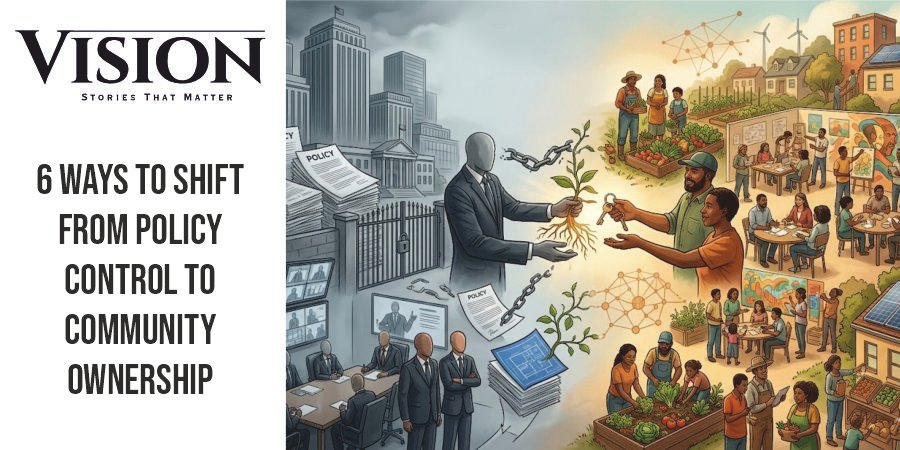
Power rarely feels fair when it sits far away. In many American cities, policies are written in offices that never hear the daily friction of a broken sidewalk, a struggling school, or a food desert. The result is predictable: systems that look efficient on paper but fail the people they are meant to serve.
Community ownership changes that equation. It moves decision-making closer to lived experience. Instead of treating people as recipients of policy, it treats them as co-creators of solutions. At its core, a community is not just a location but a shared identity, values, and participation in common outcomes . Ownership builds on that by giving people real influence over resources, priorities, and accountability .
Here’s how organizations, local governments, and institutions can make that shift in a way that actually works.
1. Redefine Authority at the Ground Level
Most policy systems centralize control by default. Decisions move top-down, often justified by efficiency. But efficiency without context leads to blind spots.
Shifting to community ownership starts by relocating authority. That could mean neighborhood councils deciding how funds are used, or school boards including parents and students in curriculum choices.
Participatory governance models show that when citizens are directly involved, policies become more responsive and better aligned with real needs . The practical takeaway is simple: stop asking for feedback after decisions are made. Bring people in before the first draft exists.
2. Turn Consultation Into Co-Creation
Public consultations often function as a checkbox exercise. A survey here, a town hall there. Then the system continues unchanged.
Community ownership requires a deeper shift. Residents must be involved in designing solutions, not just reacting to them. This is where co-creation replaces consultation.
For example, instead of asking, “Do you support this housing plan?” cities can ask, “What would housing stability look like in your neighborhood?” The difference is subtle but powerful. It changes people from respondents into architects.
When communities shape the process, they are more likely to trust and sustain the outcomes.
3. Build Systems Around Local Assets, Not Deficits
Traditional policy frameworks often start by identifying problems. Crime rates. Poverty levels. Infrastructure gaps.
Community ownership flips the lens. It begins with assets. Skills, networks, local businesses, cultural knowledge.
Community governance research highlights the importance of mapping local capacities to understand strengths alongside weaknesses . This approach changes how solutions are built. Instead of importing external fixes, systems grow from what already exists.
A neighborhood with strong informal support networks might not need more services. It may need resources to scale what is already working.
4. Share Financial Control, Not Just Responsibility
Ownership without control is symbolic. Real community ownership includes financial decision-making.
Participatory budgeting is one of the clearest examples. Cities like New York and Chicago have experimented with allowing residents to decide how portions of public budgets are spent. The impact goes beyond the money itself. It builds civic literacy and trust.
When people see where funds go, and have a say in it, accountability stops being abstract. It becomes personal.
Organizations can apply the same principle internally. Give teams or local chapters budget authority tied to outcomes they define themselves.
5. Design for Long-Term Stewardship
Policy control often operates in cycles. Election cycles. Funding cycles. Quarterly targets.
Communities, however, think in terms of continuity. Schools, parks, and local economies are not short-term projects. They are generational systems.
Community-owned models, such as land trusts or cooperatives, work because they prioritize stewardship over quick wins. In many cases, communities that own assets value and maintain them more effectively because they directly benefit from their success .
The shift here is strategic. Stop designing for immediate outputs. Start designing for long-term care.
6. Measure What Actually Matters to People
Policy systems love metrics. But many of those metrics miss the point.
A city might track the number of housing units built. Residents care about whether they can afford to live there. A school might measure test scores. Parents care about whether their children feel safe and confident.
Community ownership requires redefining success. Metrics should emerge from the community itself.
This is where many initiatives fail. They adopt the language of community ownership but continue measuring success through institutional lenses. The result is a disconnect between reported success and lived reality.
When communities define outcomes, systems become more honest. And often, more effective.
The Real Shift: From Control to Trust
Moving from policy control to community ownership is not a structural tweak. It is a mindset shift.
It asks institutions to give up a degree of certainty. It asks communities to take on responsibility alongside power. That balance is not always comfortable.
But the alternative is familiar. Policies that look polished but fail quietly on the ground.
Across the U.S., there are growing examples of communities reclaiming ownership of land, resources, and governance, often to rebuild systems that reflect their values and lived experiences. These models are not perfect. They are complex, sometimes messy. But they are closer to reality.
And that is the point.
When people shape the systems they live in, those systems begin to feel less like control and more like belonging.