


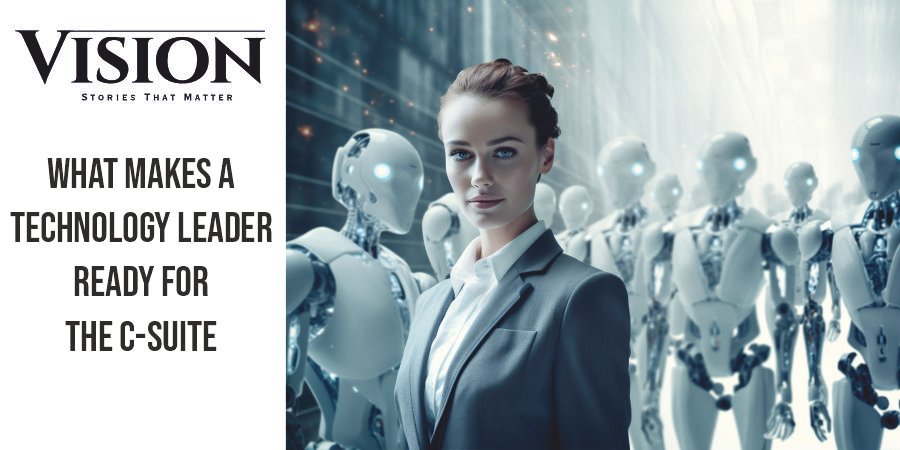
For years, technology leaders could build successful careers by being the person who understood the systems, infrastructure and technical decisions that kept a business running. That is no longer enough.
As technology moves closer to the center of business strategy, the path from CIO, CTO or senior technology leader to the C-suite is changing. Companies increasingly expect technology executives to understand customers, revenue, operations, risk and growth, not simply technology.
McKinsey’s 2026 Global Tech Agenda describes the shift clearly: leading CIOs are becoming “strategy architects,” using AI and data to reshape operating models and create measurable business value. Gartner similarly identifies strategic thinking, executive communication and change leadership as essential skills for CIOs looking to expand their influence beyond IT.
So, what actually makes a technology leader ready for the C-suite?
It Starts with Thinking Beyond Technology
The biggest shift happens when a technology leader stops viewing the business through an IT lens.
A C-suite executive needs to understand how the entire company makes money, where customers are coming from, what affects margins, which markets are growing and where the biggest risks sit.
That means a technology leader should be able to look at a cloud migration, AI investment or cybersecurity program and explain more than its technical benefits.
The more important question is: What does this do for the business?
MIT Sloan makes a similar point in its research on the evolution of the CIO. Technology leaders need to balance technical expertise with business strategy, including revenue generation, competitive differentiation, board relationships and change management.
That is the difference between being a strong technology executive and being an enterprise leader.
Business Language Matters More Than Technical Vocabulary
A technology leader can be technically brilliant and still struggle in the C-suite if they cannot communicate with people outside their function.
Boards and CEOs do not necessarily need to understand every technical detail behind an initiative. They need to understand the decision, the investment, the risk and the expected outcome.
Instead of explaining why a new technology platform is technically superior, a C-suite-ready leader should be able to explain how it could improve customer retention, reduce operating costs, accelerate product development or create a new source of revenue.
This is also where storytelling becomes important.
MIT Sloan notes that technology executives need to build a compelling narrative connecting the technology roadmap with business priorities rather than presenting a collection of technical facts.
The strongest technology leaders make complex subjects easier for everyone else to understand.
They Take Ownership of Business Outcomes
Being responsible for technology is different from being accountable for business results.
A C-suite leader cannot say, “The system was delivered on time,” and consider the job finished.
The next questions are harder.
Did customers actually use it? Did productivity improve? Did revenue increase? Did the investment create enough value to justify its cost?
This shift toward measurable business outcomes is becoming particularly important as companies invest heavily in AI. Gartner’s recent research highlights a growing gap between AI spending and the ability of organizations to measure its returns, putting greater pressure on CIOs and other executives to prioritize governance, business cases and measurable value.
A technology leader ready for the C-suite understands that successful implementation is only the beginning.
They Can Lead Change, Not Just Projects
Large technology initiatives rarely fail because of technology alone.
They fail because employees resist the change, business units work in silos, priorities shift or leaders underestimate how difficult it is to change established ways of working.
That makes change leadership one of the most important capabilities for an aspiring C-suite executive.
A technology leader needs to bring people along, make difficult decisions, resolve disagreements and maintain momentum when a transformation becomes uncomfortable.
McKinsey’s research on successful technology leaders highlights change management and people leadership alongside business and technical expertise.
The ability to get an organization moving in the same direction can ultimately matter more than knowing every technical detail.
They Know When Technology Should and Shouldn’t, Be Used
C-suite readiness also requires judgment.
Technology leaders are surrounded by new tools, platforms and promises. AI has made that challenge even more obvious. Every new technology can look like an opportunity, but not every opportunity deserves investment.
A senior executive needs to know when to experiment, when to scale and when to walk away.
MIT Sloan’s recent work on technology leadership in an AI-first environment emphasizes that CIOs should help shape company strategy while remaining grounded in what technology can realistically deliver.
That requires curiosity, but also restraint.
The best technology leader isn’t the one who adopts the most technology. It is the one who knows which technology can actually move the business forward.
They Can Work with the CEO and the Board
The move into the C-suite changes the audience.
A technology leader who previously spent most of their time with engineers, architects and IT managers may suddenly need to present regularly to CEOs, boards, investors and other business executives.
That requires a different level of executive presence.
The leader must be comfortable discussing budgets, risk, strategy, regulation, talent and long-term investment decisions. They also need enough confidence to challenge assumptions without turning every disagreement into a technical debate.
McKinsey has found that high-performing IT organizations are significantly more likely to have senior technology leaders deeply involved in strategic planning.
In other words, the C-suite conversation should not begin when someone receives a promotion. A technology leader should already be participating in that conversation.
They Build Leaders, Not Dependents
Another sign that someone is ready for the C-suite is what happens when they leave the room.
If every decision still needs their approval, they may be an excellent functional leader, but they have not yet built an organization that can operate without them.
C-suite leaders need strong successors, capable managers and teams that can make decisions independently.
That requires delegation and coaching rather than simply maintaining control.
It also changes the leader’s own role. As responsibilities expand, spending every day solving operational technology problems becomes impossible. The leader needs to create systems, develop people and focus attention on the decisions that genuinely require executive involvement.
The Real Test is Enterprise Leadership
Ultimately, a technology leader becomes C-suite ready when the organization stops seeing them as the technology person.
They become the executive who happens to have deep technology expertise.
That distinction matters.
The modern CIO or CTO may influence product strategy, customer experience, operations, talent, cybersecurity, AI adoption and even new business models. McKinsey’s 2026 research describes technology leaders as increasingly central to growth and value creation rather than simply responsible for the technology function.
The technical foundation still matters. In fact, it can be a significant advantage.
But it is no longer the destination.
A technology leader ready for the C-suite understands the business, communicates with clarity, makes decisions through the lens of value, leads people through change and can sit at the executive table as an equal.
The journey from technology leader to C-suite executive is ultimately less about knowing more technology and more about learning to lead the entire business.