


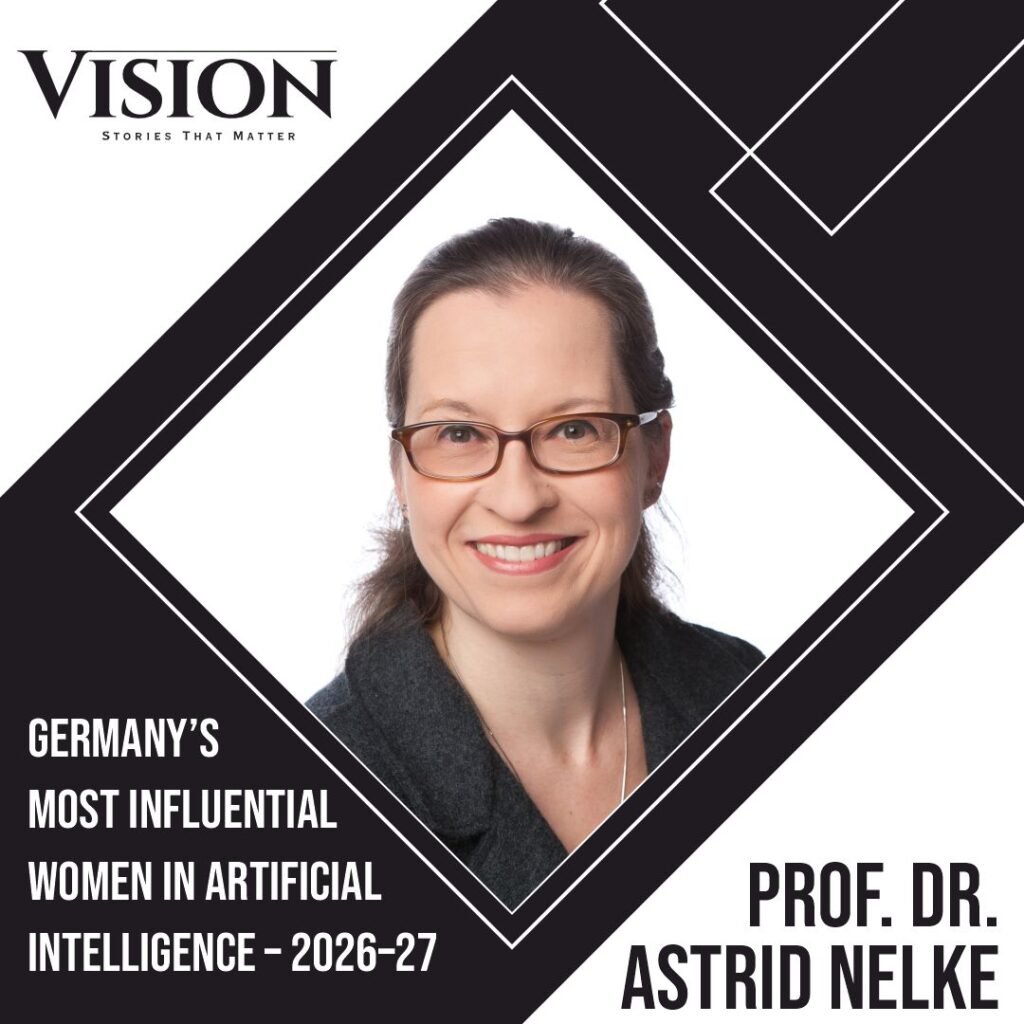
Dr. Astrid is helping organisations embrace technological change while protecting the human capabilities, values and purpose that give work its meaning.
A person can learn a new AI tool in an afternoon. Learning what that tool means for their work, their expertise and the way they see themselves can take much longer. That is where the real tension around artificial intelligence begins, in the space between what technology can do and how prepared people are to work alongside it.
For Prof. Dr. Astrid Nelke, this gap became the starting point of her work with AI. Her path into artificial intelligence was not born in a computer science lab, but in the lecture hall and boardrooms where human dynamics unfold. Throughout her career as a professor, author, and corporate consultant specializing in internal communication, employer branding, and talent management, she observed a growing structural friction in organizations: rapid technological disruption colliding with deeply human anxieties.
When modern generative AI emerged at scale, she immediately recognized that the true challenge would not simply be algorithmic capability, but organizational adoption and communication. The critical question was not just “What can the machine do?” but rather “How do human beings adapt their sense of competence, identity, and collaboration when the machine becomes a co-worker?”
It was a question that brought together everything Astrid had been observing throughout her career. Technology could change the way work was performed, yet people still had to find their place within that change. They had to understand new expectations, develop new forms of competence and make sense of working alongside intelligent machines.
“I was drawn to AI because I wanted to solve the widening gap between technological engineering and human readiness,” Astrid explains. “I felt a powerful pull to build a bridge between the technical vanguard and the workforce.” That bridge became central to her approach: demystifying AI, embedding strategic competence across diverse corporate teams, and ensuring organizations transform without losing their human core.
Her work begins in that human space, where technological progress meets the people expected to embrace it. For Astrid, understanding AI therefore means understanding the people who will work with it.
The Moment AI Became a Mission
The shift from AI as an area of interest to a field where she could create lasting impact came during an executive workshop focused on digital transformation and internal communication. Astrid and the participants were evaluating early workflow integrations of generative AI within talent management and corporate communications.
The room was sharply polarised. On one side were early tech enthusiasts championing radical automation, and on the other were highly experienced, values-driven professionals paralysed by uncertainty, fearing the erosion of craft and ethics.
In that room, it became crystal clear to Astrid: technology without structured internal dialogue and values-based leadership breeds alienation, whereas technology paired with transparent competencies unlocks human potential.
She realised that her most lasting contribution would be to pioneer frameworks for Human-AI Teaming, establishing clear competence profiles, guiding workforce transformation, and framing AI as an augmentative intellectual partner rather than a workforce replacement. That realisation turned AI from an academic interest into her primary mission.
Why AI Adoption Fails Before the Technology Does
Having seen how differently people could respond to the arrival of AI, Astrid became increasingly focused on the assumptions organisations make when deploying it. She identifies the single biggest misstep as the persistent belief that AI deployment is purely an IT or operational efficiency challenge.
Organisations often adopt tools from the top down, assuming that workforce productivity will automatically follow. This creates what Astrid calls “the adoption paradox”: sophisticated tools handed to unprepared people, resulting in shadow workflows, heightened anxiety, or superficial use cases.
In her consulting, executive education, and academic research, she actively works to correct this by shifting the focus towards competence management, internal communication, and behavioural readiness. AI must be designed and implemented with the socio-psychological architecture of teams in mind.
Before deploying systems, leaders must clearly communicate the “why,” establish transparent ethical guardrails, and actively build AI literacy across all generational cohorts, from Gen Z digital natives to seasoned senior executives.
What Kept Her Going When AI Faced Resistance
Working at the intersection of academia, entrepreneurship, and emerging technology has required immense stamina, particularly when human-centred AI integration and new organisational models were still viewed with scepticism. In the early phases, traditionalists viewed AI as a fleeting trend, while pure technocrats dismissed the psychological and cultural dimensions as “soft issues.”
What kept Astrid going was an unshakeable belief in empirical research and the human imperative. She could see the structural talent shortages and organisational transformations on the horizon; she knew that organisations unable to synthesise human talent and AI would struggle to survive.
That experience formed the lesson on resilience she now shares with emerging leaders: conviction should be grounded in deep substance and clear values. Hype cycles are volatile, but structural fundamentals, including clear communication, continuous learning, and empathy, remain timeless.
For Astrid, resilience is not about stubborn endurance; it is the discipline to stay curious, adapt methods, and maintain integrity when navigating uncharted territory.
The Achievement Hidden Behind AI Transformation
The outward signs of AI transformation are easy to recognise. Outsiders often evaluate it through the lens of automated output, such as faster reports, code generation, or streamlined workflows. Astrid considers her proudest achievement to be something far less visible: solving the psychological fear of obsolescence in knowledge work.
Through her published frameworks, lectures, and consulting initiatives on talent management and human-AI collaboration, she has developed structured methods to categorise different team archetypes, from eager innovators to those experiencing AI-related apprehension.
By establishing clear competence models and structured dialogue, these methods transform fear into self-efficacy. When an experienced employee transitions from viewing AI as an existential threat to utilising it as a powerful cognitive sparring partner, the real breakthrough occurs.
Enabling that human shift is what Astrid considers her most meaningful work.
Why Diversity is a Functional Requirement for AI
Astrid’s focus on people also shapes how her views representation within the AI landscape. She sees notable strides, with inspiring female leaders driving technical research, policy, and organisational transformation. Yet women remain substantially underrepresented in executive decision-making and AI systems architecture.
For her, the fundamental misconception the industry still holds is treating diversity as a superficial quota or a branding exercise rather than a critical functional requirement.
AI systems mirror the perspectives, biases, and blind spots of their creators. If AI is designed, trained, and deployed primarily by a homogeneous group, the resulting tools will inevitably perpetuate narrow organisational paradigms.
Diversity in AI is therefore about cognitive breadth, ethical balance, and building resilient systems that reflect the multi-faceted reality of global society.
The Projects She Chose to Walk Away From
A commitment to human-centred transformation also influences the difficult decisions Astrid makes in consulting and strategic leadership. One of the most challenging has been choosing to decline lucrative projects that prioritise rapid cost-cutting and aggressive workforce reductions under the guise of “AI automation.”
There is often tremendous market pressure to sell quick-fix AI solutions that promise overnight efficiency at the expense of corporate culture and sustainable talent development. Deciding to walk away from initiatives that lack ethical foundations or genuine commitment to employee reskilling was difficult from a short-term commercial standpoint.
However, leadership credibility cannot be compromised. Astrid anchored her decision in long-term principles: sustainable transformation requires empowering people, not discarding them. Upholding that standard has reinforced her reputation as a trusted, values-driven thought partner.
Preparing People for the Next Stage of AI
Projecting forward, Astrid sees a major shift coming in the way organisations and people work with artificial intelligence. The most transformative development over the next 5 years, she believes, will be the shift from conversational AI assistants to autonomous agentic workflows and dynamic Human-AI Teams.
Organisations are moving away from simple prompt-response interactions towards AI agents capable of planning, executing complex multi-step processes, and collaborating directly with human specialists.
Preparing for that shift requires leaders to act immediately on three fronts.
- Redefine Job Architectures: Organisations need to transition from rigid task descriptions to dynamic competence portfolios that emphasise critical thinking, strategic synthesis, and ethical judgement.
- Invest in Continuous AI Literacy: Leaders need to move beyond one-off training sessions towards a culture of continuous learning and experimentation across all levels of the organisation.
- Foster Values-Based Leadership: As technical execution becomes increasingly automated, human differentiators, including trust, internal communication, empathy, and organisational purpose, become the true drivers of competitive advantage.
Words of Wisdom
The changes ahead also make room for a wider range of people to shape the field, particularly women who may assume that technical credentials are the only route into AI. Astrid’s advice is direct: Never wait for permission to claim your seat at the table, and never dilute your unique domain perspective to fit a technical archetype.
Early in one’s career, it is easy to succumb to the belief that one must be a deep-learning engineer to determine the future of artificial intelligence. Astrid believes the truth is that AI urgently needs multi-disciplinary minds: strategists, ethicists, communication experts, and human-centric leaders who understand how technology interacts with society and human behaviour.
She encourages young women to own their expertise with intellectual rigour, cultivate relentless curiosity, and speak with authority. Their distinct vantage point is precisely what the field needs.
The Legacy She Wants AI to Leave Behind
For Astrid, the legacy she hopes to leave reaches beyond technology, commercial metrics and platforms. She wants technology to serve as an amplifier of human dignity and intellect rather than a mechanism of alienation.
She wants her academic research, books, and consulting work to have contributed to a corporate landscape where Human-AI collaboration is grounded in empathy, rigorous competence, and ethical leadership.
Beyond commercial metrics, she measures success by the enduring impact on the people she teaches, mentors, and guides.
- When a student or young professional develops the critical confidence to lead digital transformation with integrity.
- When a legacy team overcomes fear and discovers renewed purpose through continuous learning.
- When organizations build cultures where innovation and human values reinforce one another.
For her, the measure is ultimately human. When environments are created where people and technology thrive in balance, true and lasting success has been achieved.