
The Moment Before the Shift
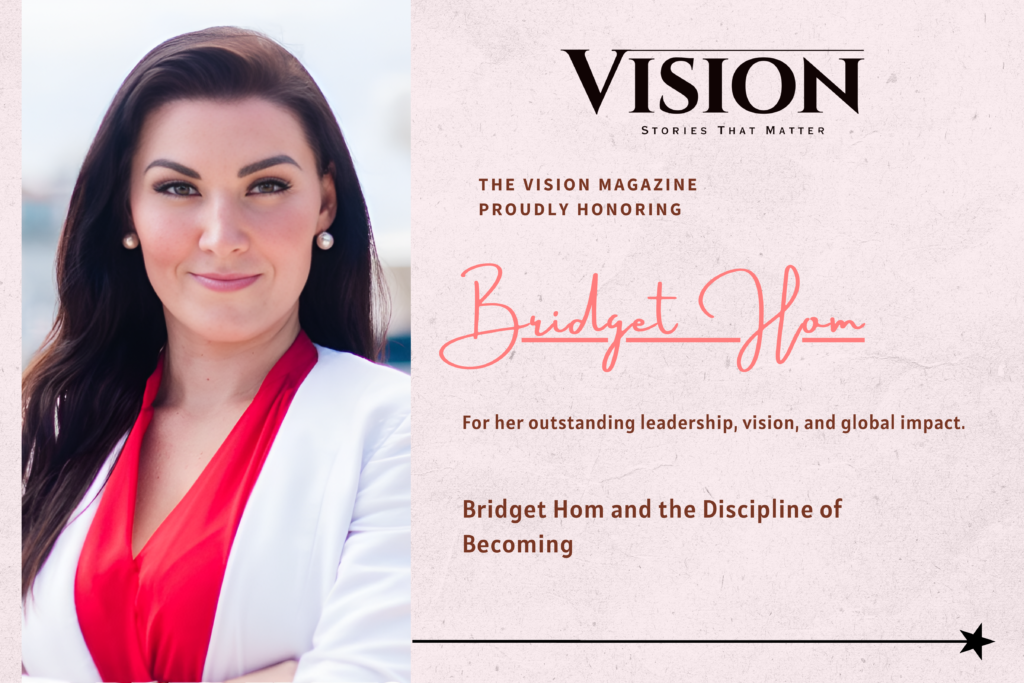
Leadership stories seem to emerge from the mountaintops but almost never from the valley below. Bridget Hom’s story does not—and cannot—begin without the valley. There was a season in this leader’s life in which aspiration seemed to pale in comparison to need. As a young, single mom of three boys, she faced the reality of that season with both the anguish it brought and the uncertainty it represented. Stability would no longer come automatically. It would have to be recalibrated. She has shared about sitting at home with just a few thousand dollars remaining in her bank account. She would have to consider what she would do next. Having become an Instacart Shopper would be less a metaphor than fact. That would have been the reality during that period, and it would have been far from inspirational. It would have been necessary. It would have been humbling. And yet, something profoundly important would soon begin. Pressure would start to define self. Instead of shrinking leadership aspirations to meet the current need, she would begin to ask another, more probing question: Who am I becoming through this? The likelihood is that a networking Zoom link popping up was not a sign of destiny, it was a sign of a little opportunity, and she took it seriously. Taking a place on that Zoom, introducing herself confidently, “Bridget Hom here with Bridge to Freedom Coaching, are you ready to level up?” It was not a performance; it was alignment in action. She was speaking from a level of herself that she had made a choice to believe in, and that was, I think, the start of everything that came next. For Bridget, vision did not start with clarity; it started with a choice.
Reinvention as a Leadership Practice
Before Bridget worked with executives and created strategic frameworks, her background was a diverse blend of ministry work, journalism, and placement services. Each of these fields requires communication, discernment, and the ability to read people. Yet none of them provided Bridget the sense of who she was until the reality of adversity brought a sense of integration. Divorce and being a single mother did not only change Bridget’s personal situation; it changed the way she saw the world from a place of control to a place of reinvention. The key that makes Bridget’s story unique and compelling is not that she changed careers; that’s quite common. Rather, the unique part is that Bridget reinvented a philosophy of leadership based not on what she read from others, but on what she learned from her own situation. She learned that many leaders can manage a successful operation, but few can manage emotions. She learned that many individuals can understand strategic concepts, but few comprehend self-awareness. Bridget’s story promotes the idea that a leader must have “inner architecture. Such an observation would later influence her development of the PrOp Method, her proprietary system of integrating emotional intelligence, innovation, and strategic problem-solving. Her methods are different from those that measure everything by starting with the mind. While others see emotional intelligence as additional to leadership, she sees that if the leader is uncalibrated inside his or her own mind, the entire organization reflects that uncalibration externally. Reinvention is an ongoing process of leadership.
The Internal Architecture of Vision
The foundation of Bridget’s view lies in four cornerstones: self-awareness, self-regulation, self-direction, and finally, self-actualization. These words are not motivational slogans in Bridget’s dictionary; they have operational consequences. The idea of self-awareness entails facing ego, insecurity, and ignorance without defensiveness. Here, intellectual humility is imperative. The second component involves translating every decision into rational intent rather than emotional response. The difference between both can mean the difference between peace and pandemonium in a hostile environment. The third element—self-direction—entails safeguarding long-term vision from short-term noise. The market will change, and so will the market’s perceptions. Resistance is inevitable. However, a real leader remains rooted. And finally, there’s self-actualization – the place where leaders no longer execute competence; instead, competence becomes them. Bridget’s emphasis on these core elements underscores her conviction about where leadership failures begin: not in strategies, but in misalignment. Her own routines operate along the same lines. Her days begin with prayer and gratitude—but not as prayer or gratitude; as a foundation. She writes as if she were in the future, clarifying things before confusion sets in. She reads across disciplines: neuroscience, sociology, storytelling—and knows that when it comes to thinking in terms of insight, it is at the crossroads of disciplines where knowledge is most apt to lie.Vision is not inspiration; it is work..
Integrity as Strategic Strength
One of the tests of Bridget’s leadership came disguised as opportunity. She was approached by a well-known organization for a partnership opportunity. From an external point of view, it was a strategic decision. From Bridget’s point of view, she felt it was not aligned. The culture internally was not aligned with her values. Most leaders would rationalize such a situation. They would quietly compromise and tell themselves they would correct the situation later. Bridget, however, did not. It was not an emotional decision; rather, it was a highly principle-driven decision. She often says that she was raised on the concept known as the Law of Deservability, which simply means that people believe they deserve what they get and do they act on it—constantly. Compromise on being aligned, she believes, sends a message internally of compromise. In today’s era, where being focused on growth more than character is the marketing message pushed to create business, Bridget’s approach stands out. Ethics are not additions for Bridget’s leader mindset. They are infrastructures. Without these, scale can be fragile. Integrity, according to her, is not limiting but rather liberating, as it weeds out distractions and helps protect one’s credibility over time. This is especially priceless as one’s visibility increases.
Innovation Without Losing Humanity
Technological acceleration is the hallmark of modern business, with automation, artificial intelligence, and digital transformation at the center of every boardroom conversation. Bridget, however, does not fight technology; she changes how we think about it: “Innovation without emotional responsibility is just disruption with good PR.” Bridget’s methodology as Bridge to Freedom Coaching and The Axiom Group brings together our understanding of technology and emotional intelligence. The former must be used for, not against, humanity. Bridget helps business leaders think not just about what is possible, but about what is responsible. This allows business leaders to avoid decision-making through reaction and trend-based approaches. Speed is attractive when competition is tight, and the pace of technological advancement is swift. However, Bridget believes sustainability is key, and it’s this which underpins her PrOp Method and emotional intelligence-based strategic thinking: “What is responsible?” She guards against the binary thinking of “what is possible?” which can be as destructive as it is creative. In an era when disruption is seen as a good thing, Bridget’s measured and considered approach is radical thinking, and it is this radical thinking which allows businesses to succeed without destroying themselves from the inside out.
Failure as Refinement, Not Identity
No leadership path is without failure, and Bridget is no different. Her coaching program wasn’t exempt from the possibility of failure. In fact, her first program launch failed catastrophically due to poor messaging. The outcome left her with a bruised ego. For any person, the tendency to attach failure to self-worth is an easy conclusion. However, she took a more pragmatic approach. After conducting her due diligence of what went wrong with the program, she recreated the program with better messaging. The outcome was that the recreated program ended up becoming one of her most successful frameworks she had created. However, the success of the recreated program is more than just a lesson; it is a philosophy. A philosophy she now applies to the emerging leaders she is now charged with coaching within the organization. While she is far from the picture of a nurturing leader who goes soft on her protégés, she throws them into real-world situations – including conference engagements, strategic planning sessions, creating content – after which she coaches them through the process. To her, real leadership is not about theory; it is about execution. Asked to define her legacy, she would list only one word: freedom. Mental freedom from limiting beliefs. Emotional freedom from fear-based decisions. Financial freedom backed by aligned strategies. Her progress is gauged not just by revenue, but by the ripple effects of her work: stronger lives, more confidence, leaders emerged from the inside out. Amidst a culture fixated by speedy gratification, Bridget Hom is the personification of disciplined becoming. And perhaps the strongest differentiation of visionary leadership in 2025 is her discipline.
Featuring: Bridget Hom
Founder, Bridge to Freedom Coaching & Co-Owner, The Axiom Group
Palm Beach, FL
www.bridgetofreedomcoaching.com