
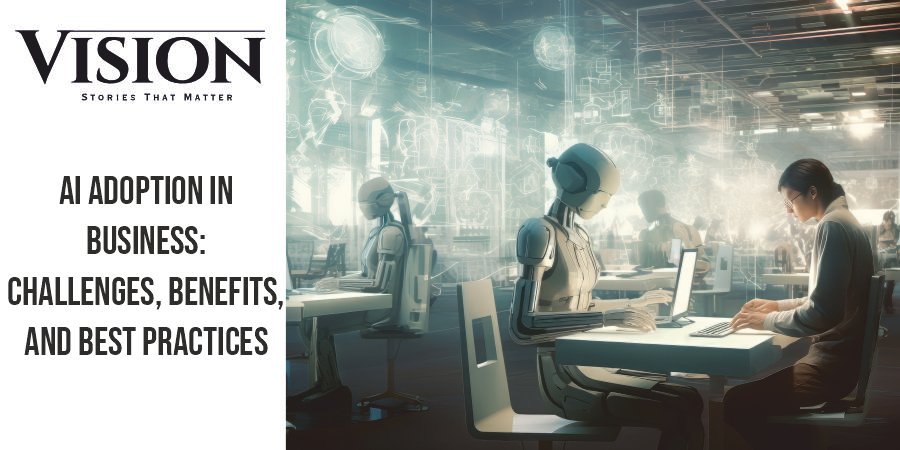
Artificial intelligence has quickly moved from an emerging technology to a practical business tool. Companies across industries are using AI to automate routine work, analyse data, improve customer experiences and help employees make faster decisions.
Yet adopting AI is rarely as simple as introducing a new software platform. Companies have to deal with concerns around cost, security, data quality and employee adoption while also figuring out where AI can create genuine value.
A successful AI strategy therefore requires a balanced view of what the technology can offer, where it can create problems and how businesses can introduce it responsibly.
What Are the Benefits of AI Adoption in Business?
AI can create value across almost every part of an organisation, particularly when it is applied to a clear business need.
- Higher Productivity
One of the most immediate advantages of AI is its ability to reduce repetitive work. Employees can use AI for tasks such as summarising documents, organising information, drafting routine communications, analysing large datasets or handling basic customer queries.
The time saved can then be redirected toward work that requires human judgment, creativity and problem-solving.
- Faster Decision-Making
Businesses generate enormous amounts of information, but having data does not automatically make decision-making easier.
AI can process large datasets quickly and identify patterns that may take people considerably longer to find. In areas such as sales, finance, supply chain management and customer service, this can help leaders respond to changing conditions more quickly.
Human oversight remains important, but AI can make relevant information easier to access.
- Better Customer Experiences
AI can help companies respond to customers faster and personalise interactions at scale.
Chatbots, recommendation systems, automated support tools and customer-data analysis can help businesses understand what customers need and respond more efficiently.
When used carefully, AI can support employees rather than simply replace human interaction.
- More Innovation
AI can also change how companies develop products, services and internal processes.
Teams can use AI to explore ideas, analyse markets, test concepts and identify opportunities. Developers can use AI-assisted tools to accelerate parts of software development, while researchers can use AI to work through large volumes of information.
This can shorten the distance between an idea and its practical application.
What Are the Main Challenges of AI Adoption in Business?
The potential benefits are significant, but companies face real obstacles when introducing AI.
- Data Privacy and Security
AI systems often require access to large amounts of information. That creates concerns about confidential business data, customer information and intellectual property.
Employees may also use consumer AI tools without fully understanding where the information they enter is stored or how it may be processed.
Companies need clear rules about what data can be used with AI and which tools employees are permitted to access.
- Inaccurate or Unreliable Outputs
AI can produce answers that sound convincing while still being incorrect.
This becomes particularly serious when AI is used for financial analysis, legal work, healthcare, customer decisions or other areas where mistakes can have significant consequences.
Businesses therefore need processes for reviewing important AI-generated outputs rather than treating them as automatically reliable.
- Employee Resistance
People may be enthusiastic about AI, uncertain about it or worried that it could eventually affect their jobs.
Introducing technology without explaining how it will change employees’ work can create resistance.
Training and honest communication are essential. Employees need to understand what the technology is intended to do, what remains their responsibility and which new skills they may need.
- Implementation Costs
AI adoption can involve more than the price of a software subscription.
Companies may need to invest in infrastructure, data preparation, integration, cybersecurity, training and ongoing maintenance.
A business should therefore evaluate the expected return before committing significant resources.
- Difficulty Integrating AI Into Existing Workflows
An AI tool can work perfectly in a demonstration and still fail to deliver value in everyday operations.
Existing systems may not connect easily with the new technology. Processes may also need to be redesigned before AI can be used effectively.
This is why implementation should be treated as a business-process decision rather than simply an IT purchase.
What Are the Best Practices for AI Adoption?
Companies can reduce many of these problems by taking a measured approach.
- Begin With a Business Problem
Do not start with the question, “Where can we use AI?”
Start with, “What problem are we trying to solve?”
Look for repetitive processes, operational bottlenecks, customer-service challenges or areas where employees spend too much time on manual work.
AI should have a clear purpose and a measurable outcome.
- Start With Small, Practical Projects
Businesses do not need to transform every department at once.
A small pilot allows a company to test a specific use case, understand the limitations and measure results before making a larger investment.
If the project works, the company can expand it. If it does not, the organisation can change direction without having committed excessive resources.
- Train Employees Properly
Technology adoption ultimately depends on people.
Employees should learn how the AI tools work, how to use them effectively and how to recognise inaccurate or inappropriate outputs.
Training should also cover data privacy, cybersecurity and responsible AI use.
The objective is to create employees who know how to work with AI thoughtfully rather than simply encouraging everyone to use it.
- Establish Clear AI Governance
Companies need straightforward policies covering approved tools, sensitive information, intellectual property, security and human oversight.
Someone should also be responsible for monitoring AI systems and addressing problems when they arise.
Good governance provides boundaries without preventing employees from experimenting with useful applications.
- Measure What Actually Changes
AI adoption should be measured through business outcomes.
Companies can track factors such as:
- Time saved
- Operating costs
- Customer satisfaction
- Error rates
- Employee productivity
- Revenue impact
- Quality improvements
Usage numbers alone do not prove that an AI investment is working.
- Keep the Human Element
AI can process information and automate tasks, but people remain responsible for judgment, context and accountability.
Companies should identify where human review is essential and make that part of the workflow from the beginning.
The strongest implementations are usually those where technology and human expertise complement each other.
The Future of AI Adoption in Business
AI adoption is likely to become a continuing process rather than a one-time technology project. New tools will emerge, employee expectations will change and companies will discover new ways to use AI.
The businesses that benefit most will not necessarily be those that adopt the largest number of AI tools. They will be the ones that understand where the technology can genuinely improve their operations and introduce it with appropriate safeguards.
For business leaders, the path forward is relatively clear: identify meaningful opportunities, understand the risks, prepare employees, start with manageable projects and measure the results.
AI can deliver significant business benefits, but responsible adoption is what turns the technology from an interesting experiment into a useful long-term capability.