
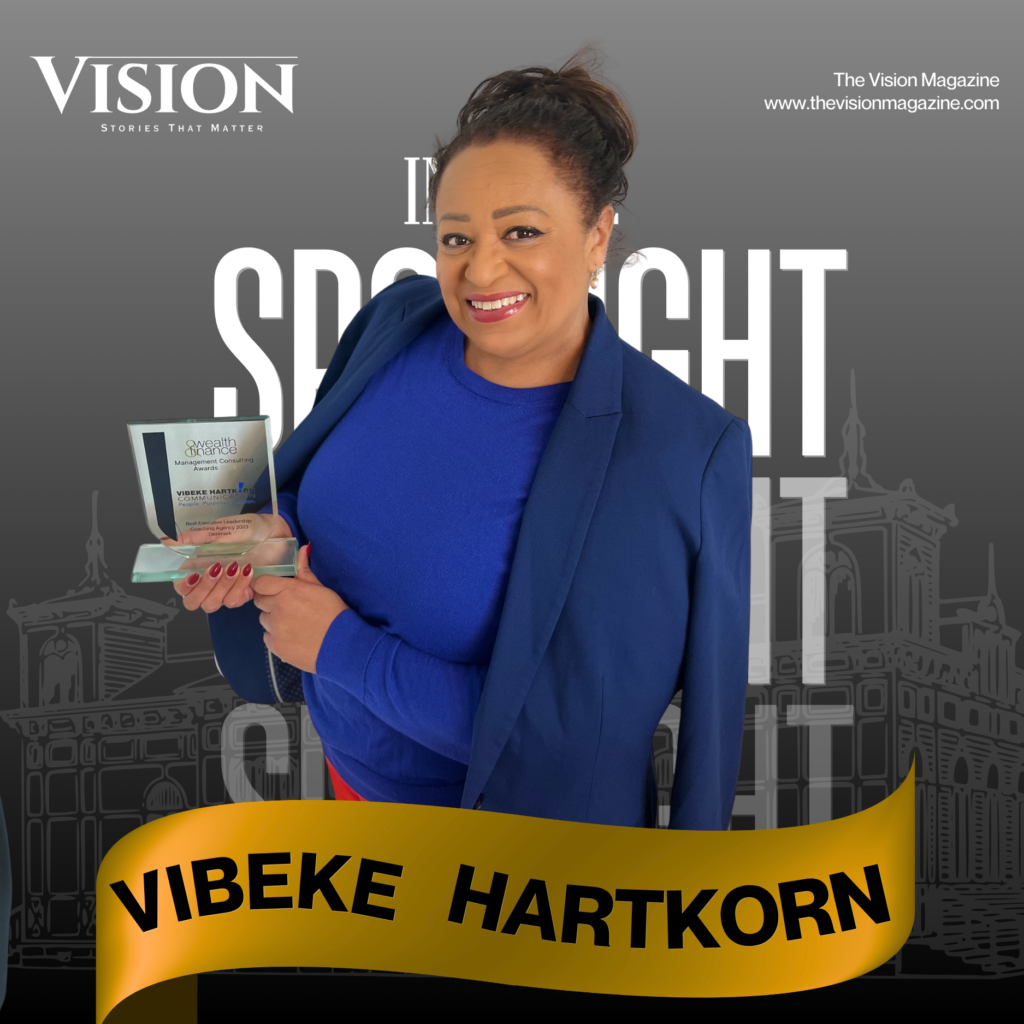
For years, businesses have invested heavily in strategy, technology, and performance systems, believing these are the main drivers of success. Yet many organizations still struggle with disengaged teams, misaligned priorities, and leaders who feel increasingly disconnected from the people they lead. Perhaps the problem is larger than strategy. Perhaps leadership challenges are, at their core, communication challenges.
Vibeke Hartkorn has spent much of her career proving exactly that.
Long before she became a trusted adviser to boards, business owners, C-level leaders, and leadership teams, Vibeke built her career in a profession where clarity could never be left to chance. She spent 16 years working as a journalist, editor, documentary filmmaker, and national news anchor, her last position being DR, the Danish Broadcasting Corporation. Those years taught her how to navigate complex situations, ask valuable questions, and translate complicated knowledge into language people could easily understand.
Making the transition into business life as a communication advisor and communication trainer, one idea continued to stay with her. She was always drawn to that special moment when people genuinely connect with one another. A moment that can change the dynamic of an individual, a team, an organization, and sometimes even an entire industry.
That belief eventually led her to establish Hartkorn Communication in 2007. Her goal was clear: bring the discipline of strong communication into leadership. Since then, she has advised leaders on strategic communication, leadership development, stakeholder management, branding, and business strategy.
For Vibeke, communication serves a much greater purpose than delivering information. It is the force that brings leadership to life. When leaders communicate with clarity, courage, and care, people gain more than an understanding of strategy. They feel included in the journey and motivated to move forward together.
Across boardrooms, leadership teams, and growing businesses, Vibeke persists in helping leaders build stronger connections with the people they serve. In a complex world filled with constant noise, her work demonstrates that meaningful leadership often begins with clear, meaningful communication.
Below are the interview highlights:
You transitioned from being an award-winning Danish journalist and national news anchor to founding Hartkorn Communication in 2007. What sparked that bold shift, and how did your media background shape your approach to strategic advising?
The honest answer is that I was stuck in a prestigious job that many people envied. But I have always needed new challenges, and I could feel I needed professional development.
Around that time, I was asked to write my first book, ‘Powerwomen,’ and my reaction was: No, no, I don’t know how to write a business book. Then, while I was on vacation in Tobago, I climbed a muddy mountainside after a hurricane. The guide wanted to turn back, but I kept going. I came down scratched, soaked, and laughing at my own stubbornness, feeling like an exhausted Indiana Jones.
That day gave me a physical memory of courage. It gave me a life truth I still follow: When we dare to challenge ourselves physically, we often build inner courage and self-worth. We discover our almost limitless ability to overcome a lack of self-confidence again and again. In many ways, that moment also explains how I work today. I help leaders develop self-belief by walking a little further into difficult terrain instead of turning back too early.
Journalism taught me to respect the audience, find the essence of a challenge, expose the dilemma, and never hide behind superficial jargon. In journalism, you learn very quickly to sense when a person is avoiding the real issue. The same is true in business. In advisory work, my job is often to train leaders in how to tell the truth – even when it’s challenging- in a way people can relate to, trust, and most importantly, act on.
Your mantra is building “3 bottom lines: People, Purpose, Profit.” Can you walk us through what each one means in practice for the leaders and companies you work with?
For me, the three bottom lines are essential to good business.
- Profit is oxygen: Without profit, a company cannot invest, innovate, or keep people employed. Build a sustainable, profitable business.
- Purpose is the compass: It tells customers, employees, partners, and the outside world the difference you make and why they should care.
- People are the energy system: Without trust, competence, psychological safety, and engagement, even the most beautiful strategy becomes a document no one lives by. Invest in the right people, and they will make sure you have a business for the future.
I work with companies who wants to connect these three bottom lines as opposed to treating them as competing agendas. We strengthen communication, leadership, corporate culture, workplace ethics, retention, stakeholder management, and business growth. The leaders I work with do not choose between commercial ambition and responsibility towards people. They learn the benefit of making the two belong together.
As a board member and chair for private industrial firms, startups, and public companies since 2007, what’s the biggest lesson you’ve learned about driving growth and go-to-market strategies in today’s volatile markets?
My biggest lesson is that the boardroom must never become a museum for yesterday’s success. You must keep learning, keep diving into the unknown, and test assumptions. Volatile markets punish arrogance, but they reward learning.
For me, strong board work begins with asking the right questions. What are customers beginning to value differently? Which global trend will reach us, and are we ready? Growth is not just a strategy plan. It is a living relationship with the market, and the best boards listen before acting.
I do worry that the discipline of decision-making is becoming too scarce. Too many leaders wait too long to act. As a board member, I support the executive management to become proactive and future ready.
Customer centricity seems central to your board work; how do you help organizations shift from product-focused to truly customer-driven cultures?
As a board member and a board advisor, I often state that customers are not as interested in our product or service as we might be. They are interested in the difference our product makes in their lives and how the product helps the world become a better place.
A product-focused organization asks: What do we want to sell?
A customer-driven organization asks: What problem are we truly solving, what experience are we creating, and why should the customer keep choosing us?
I focus strongly on customer insight, focused sales, branding, and market trends. At Hartkorn Communication, we bring customer evidence into management meetings and boardrooms: interviews, segmentation, complaints, user journeys, sales analyses, and why customers choose, stay, or leave. The point is to make the customer a reality in the meeting room.
In your role as an advisor, you’ve guided companies on branding and stakeholder communication. What’s a common pitfall you see in growth strategies, and how do you fix it?
A common pitfall is forgetting that growth is experienced differently by different stakeholders. Leaders may think about customers and shareholders, but might not be focused on e.g., employees, partners, authorities, or affected communities.
Then the external story sounds convincing while the internal reality becomes insecure. I begin by mapping the stakeholder landscape: Who must understand, believe, feel threatened, or be heard before they can support your actions? Effective communication is built on trust. I often say that ‘good communication is easy when trust is high.’
You coach top management on leadership and team development. Can you share a story of an executive team that transformed under your guidance, and what made the difference?
I feel very lucky. For 18 years, I have seen this transformation happen again. And again. My recipe is simple, and it creates results. I help you become aware of how people experience you; I support your personal growth journey and help you find your leadership compass.
Self-awareness is the turnkey to making people choose you as a leader worth following. One leader who comes to mind was introverted, technically brilliant, and not a naturally strong communicator.
With his permission, I filmed his meetings and calls. Watching himself made him realize what others felt: not a lack of professional competence, but a lack of connection with his team and customers.
Bringing in communication training, we worked with meaningful messaging and a more personal, storytelling, and acknowledging style of communication. It changed the dynamic completely.
At every new leadership level, there is something we must stop doing, keep doing, and start doing. Then you will begin to deliver with real confidence and connect with your stakeholders.
For business leaders navigating career strategies, what advice do you give on building resilience and personal impact in high-stakes environments?
My advice is to stop treating resilience as the ability to endure everything alone. Resilience is built through self-knowledge, deep-dive preparation, the ability to recover quickly, and the courage to seek qualified advice.
In high-stakes environments, leaders must know their own pressure pattern. Do you become controlling, silent, pleasing, defensive, or chaotic? If you do not know your pressure pattern, people around you probably already do, and over time, it will undermine your ability to lead others.
Resilience is about staying put no matter what. But also realizing when enough is enough and when to move on. Do not stay in a toxic environment just to prove how strong you are. Choose a workplace where toxic behavior is not accepted and where the organization is committed to kindness.
As a trainer in communication, performance, and challenging conversations, how do you teach leaders to handle conflict and turn tough dialogues into opportunities?
I teach leaders to combine structure with humanity. Employees do not only follow decisions; they follow the way decisions are made and communicated.
During change, people need to know what is new, what we will stop doing, and what we are protecting. Leaders often try to calm employees by being vague or too positive, but people sense when something is being softened. I would rather hear a leader say: “I can feel this creates concern, and that is understandable. I do not have all the answers yet, but I will be honest about what I know.”
Honesty is not brutality. Empathy is not weakness. The opportunity in uncertain times is that it reveals what people care about. When leaders can acknowledge emotions without feeding helplessness, difficult conversations become a path to clarity, responsibility, and renewed trust.
You’ve moderated business conferences, facilitated executive teams, and chaired boards. What’s your secret to keeping diverse groups collaborative and productive?
The 3 P´s: Preparation, presence, and a bit of playfulness. Whether I moderate a conference, facilitate an executive team, or a strategic board day, I always try to understand the people in the room before moving them forward.
- What are their strongest dreams and ideas?
- Where is the tension or dilemma?
- Who needs to be heard?
- What can only happen live, in that moment?
I like to make sessions energetic and sometimes bring people out of their comfort zone. A group tending to think slowly may need to make faster decisions. A group that hides behind analysis may need to speak more personally. Humor helps because it lowers power struggles without lowering ambition.
As an author of four business books and a speaker on topics like personal impact, career paths, media positioning, and customer-centricity, which idea from your books has resonated most with audiences?
The idea that resonates most is that leadership development requires both learning and unlearning. In my book ‘Effective communication for all leadership levels- make people follow you’, I wrote about how leaders need different communication skills as they move through the leadership pipeline.
Many talented people are promoted because they were excellent in one role, and then they unconsciously continue using the same behavior in a role that calls for something different. “What brought you here will not necessarily take you there”. That sentence often resonates with leaders.
The specialist must stop solving every task herself and start creating results through others; the manager must stop focusing only on daily operations and learn to communicate direction, priorities, and strategy; the executive must stop looking mainly inward at the organization and begin to lead in relation to the greater complexity of the outside world.
You co-founded the relationship psychology platform GreatRelations.com. How does understanding relationships tie into effective leadership and board collaboration?
Great Relations grew naturally out of my work with communication skills, leadership, and team connection. Since 2016, I have trained as a psychotherapist, and across all my roles – as a journalist, executive coach, and therapist – I have seen how essential the quality of the conversation is.
As a therapist, I focus on bringing psychological safety into relationships and organizations. The method I prefer, awarded by the American Psychological Association’s Goldstar, is called Emotionally Focused Therapy (EFT), and has taught me that most conflicts are not really about the topic. Conflicts are always about the emotional cycle that has turned negative between people.
In couples, that may look like criticism and withdrawal; in leadership teams, it might look like control, silence, escalation, or polite avoidance. I believe that the individual is not the problem – the negative behavioral pattern between two people is the problem. When we see and reverse patterns, we can change the dialogue and find a positive outcome.
Projecting forward, with your focus on Powerwomen/Powermen and MeToo prevention strategies, what role do you see authentic leadership playing in fostering inclusive, profitable organizations?
Authentic leadership is decisive because inclusion cannot be delegated to a policy. Policies and training set the goal and foundation for new behavior, but culture is created in everyday moments: who is interrupted, who is invited in, who is believed, who is bullied?
My work has made me deeply interested in power. Healthy power creates opportunity and high performance. Unhealthy power creates fear and lost talent.
Inclusive organizations become more profitable because people dare to contribute fully, challenge decisions, innovate, and stay through challenging times. Authenticity is not saying everything you feel. It is reducing the distance between your values, your decisions, and the way people experience your leadership. That is where trust begins.
Meet Vibeke Hartkorn here:
- www.hartkorncommunication.com
- www.great-relations.com
- http://dk.linkedin.com/in/vibekehartkorn


